Wedding photography · Kit
What lenses do I use at a wedding? My 35mm and 85mm
The two Sigma prime lenses and two Sony cameras I use for most of a wedding day, what each one is for, and how they shape your wedding photos.

Contents
In short
What lenses and cameras do you use on a wedding day?
My two favourite lenses on a wedding day are the Sigma 35mm f/1.2 DG DN Art and the Sigma 85mm f/1.4 DG DN Art. I use them on a Sony a7 IV, with a Sony a7C as my second camera. The 35mm is my storytelling lens, and the 85mm is my portrait lens.
- The 35mm f/1.2 tells the story of the day and copes with very low light.
- The 85mm f/1.4 gets up close for portraits, with beautifully soft backgrounds.
- The Sony a7 IV’s autofocus keeps up with real moments; the a7C is small, light and quick to grab.
I’ll admit it: I’m a gadget person at heart. Camera gear fascinated me long before I photographed my first wedding, so couples sometimes ask what’s actually in my bag on the day.
This post is the honest answer, with what each lens and camera does and, more importantly, how it changes the photos you get. You don’t need to know any of this to have a lovely wedding, but if you’re curious, here’s how it works.
The basics
Why I use prime lenses
A prime lens has one fixed focal length, so it doesn’t zoom. That sounds like a limitation, but for weddings it’s a strength:
- They let in far more light. A typical wedding zoom opens to f/2.8. My 35mm opens to f/1.2 and my 85mm to f/1.4. In plain terms, f/1.2 lets in more than five times as much light as f/2.8, and f/1.4 four times as much.
- They blur the background beautifully. A wide aperture keeps you sharp and softens everything behind you, which hides fire exits, clutter and passing guests.
- They keep me moving. With no zoom, I walk closer or step back. It makes me think about every frame instead of standing in one spot.
Two good primes do most of the work, which also means less kit to carry and quicker changes between moments.
Getting ready and the story
The Sigma 35mm f/1.2: my storytelling lens
The 35mm is the lens I reach for during getting ready. Bedrooms and bridal suites are often small and busy, and 35mm is a little wider than a standard lens: wide enough to show the moment and what’s around it, like the mirror, the window light or a parent watching from the doorway, without the stretched look of a very wide lens.
It sits close to how we naturally see a scene, which is why documentary and press photographers have loved this focal length for decades. Photos taken with it feel like you were there.


Then there’s that f/1.2 aperture. When Sigma launched this lens in 2019, it was the first autofocus 35mm f/1.2 made for Sony and L-Mount full-frame mirrorless cameras. It’s superb in low light, so hotel rooms in winter and old buildings with small windows aren’t a problem, and I can work with the light that’s already there instead of reaching for a flash. And the bokeh, the soft blur behind your subject, is phenomenal at f/1.2.
It’s a big, heavy lens, but it’s built to resist dust and splashes, which is reassuring on a drizzly British wedding day.
Portraits
The Sigma 85mm f/1.4: my portrait lens
If the 35mm tells the story, the 85mm shows the feeling. It’s a classic portrait focal length, and for good reason:
- It gets up close. I can fill the frame with your face from a few metres away. For couples who find cameras unnerving, that distance makes a real difference: I’m close to the moment without being in it.
- It’s flattering. Because I stand further back, faces keep their natural proportions, with none of the distortion you get from close up with a wide lens.
- It turns backgrounds into soft colour. At f/1.4, with eleven rounded aperture blades, the background melts into gentle shapes and tones, so even an ordinary hotel garden can look calm and romantic.

It’s also the lens I like for quiet moments with guests, like a grandparent’s face during the speeches, where walking up close would break the spell.
A note on the photos in this post: they’re from weddings I’ve photographed, chosen to show the kind of moment each lens suits.
The bodies
My two cameras: the Sony a7 IV and the a7C
The Sony a7 IV is my main camera. Its autofocus is brilliant: it tracks eyes in real time across most of the frame, which matters when you’re walking down the aisle or spinning on the dance floor, and nobody is going to stop and pose. Its 33-megapixel sensor also gives plenty of detail for prints and albums.
The Sony a7C is my second camera. It’s a full-frame camera in a remarkably small, light body, about half a kilo, so I can carry it all day and switch to it in a second without changing lenses. It’s honestly a joy to use, and it’s my favourite camera to take on holiday too.
Carrying two cameras means one can wear the 35mm and the other the 85mm, so I never miss a moment while swapping lenses, and there’s always a backup if anything goes wrong.
Light
Why fast lenses matter in dim venues
Plenty of beautiful UK venues are dark inside: churches, historic register offices, candlelit barns and anywhere on a winter afternoon. Many ceremonies also limit or ban flash while you say your vows, so it’s worth asking your venue or registrar about their photo rules early.
Fast lenses are how I deal with that. Letting in more light means I can keep a quick enough shutter speed to freeze a moment and keep skin tones natural, without lighting up the room or distracting anyone.

The point of it all
What this means for your wedding photos
| Kit | Best for | Why |
|---|---|---|
| Sigma 35mm f/1.2 DG DN Art | Getting ready, small rooms, the story of the day | Shows the moment and its surroundings; superb in low light |
| Sigma 85mm f/1.4 DG DN Art | Couple portraits, close-ups, quiet moments | Flattering, soft backgrounds, and I can stay out of the way |
| Sony a7 IV | My main camera, all day | Real-time eye tracking keeps moving moments sharp |
| Sony a7C | My second camera | Small and light, so the other lens is always ready |
Good kit isn’t the whole story, of course. The biggest difference to your photos is how relaxed you feel, which is why I spend time getting to know couples before the day. There’s more about that on my About page, and you can see the results in my portfolio.
If you’d like to read about the different ways photographers work on the day, my guide to wedding photography styles explains them.
Sources
- Sigma: 35mm F1.2 DG DN | Art press release, July 2019.
- Sigma: 85mm F1.4 DG DN | Art, product information and specifications.
- Engadget: Sony’s A7 IV arrives with a 33-megapixel sensor, October 2021.
- PetaPixel: Sony unveils the ultra-compact a7C, September 2020.
- SLR Lounge: why the 85mm suits portraits.
- PetaPixel: why the 35mm suits wedding photography.
Checked on 12 November 2026.
Questions about wedding photography kit
What lenses do wedding photographers use?
Most use a mix of fast prime lenses and zooms. Popular choices are a 35mm and an 85mm prime, sometimes with a 50mm, plus a 24–70mm or 70–200mm zoom. I use a Sigma 35mm f/1.2 and a Sigma 85mm f/1.4 for most of the day.
Is 35mm or 85mm better for weddings?
They do different jobs. A 35mm is better for telling the story and working in small rooms, while an 85mm is better for flattering portraits and close-ups from a distance. Many photographers carry both.
What camera do you use for weddings?
A Sony a7 IV as my main camera, for its fast, reliable eye-tracking autofocus, and a compact Sony a7C as my second camera, so each of my two main lenses is always ready to shoot.
Why do wedding photographers use prime lenses?
Primes usually let in much more light than zooms, which helps in dark churches and evening venues, and their wide apertures give soft, blurred backgrounds.
Do wedding photographers use flash in church?
Usually not during the ceremony itself. Many churches and registrars limit or ban flash during the vows, so photographers rely on fast lenses and the light that’s already there. Ask your venue about its rules.
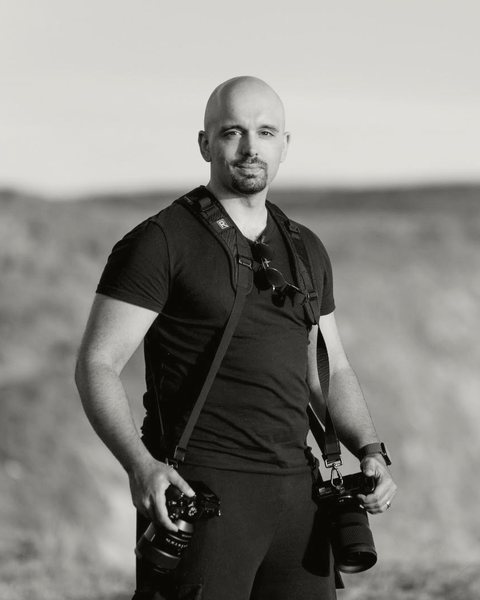
Written by
Pedro de Sousa
I’m a wedding photographer based in Goffs Oak, Hertfordshire, photographing weddings since 2017. My style is natural and documentary-led: I stay out of the way, capture what really happens, and guide you gently through the portraits.